 Add to Chrome
 Add to Firefox
 Add to Edge
Hierarchical Semantic-Augmented Navigation: Optimal Transport and Graph-Driven Reasoning for Vision-Language Navigation
Jun 01, 2026
Vision-Language Navigation in Continuous Environments (VLN-CE) poses a formidable challenge for autonomous agents, requiring seamless integration of natural language instructions and visual observations to navigate complex 3D indoor spaces. Existing approaches often falter in long-horizon tasks due to limited scene understanding, inefficient planning, and lack of robust decision-making frameworks. We introduce the \textbf{Hierarchical Semantic-Augmented Navigation (HSAN)} framework, a groundbreaking approach that redefines VLN-CE through three synergistic innovations. First, HSAN constructs a dynamic hierarchical semantic scene graph, leveraging vision-language models to capture multi-level environmental representations, from objects to regions to zones, enabling nuanced spatial reasoning. Second, it employs an optimal transport-based topological planner, grounded in Kantorovich's duality, to select long-term goals by balancing semantic relevance and spatial accessibility with theoretical guarantees of optimality. Third, a graph-aware reinforcement learning policy ensures precise low-level control, navigating subgoals while robustly avoiding obstacles. By integrating spectral graph theory, optimal transport, and advanced multi-modal learning, HSAN addresses the shortcomings of static maps and heuristic planners prevalent in prior work. Extensive experiments on multiple challenging VLN-CE datasets demonstrate that HSAN achieves state-of-the-art performance, with significant improvements in navigation success and generalization to unseen environments.

CogniVerse: Revolutionizing Multi-Modal Retrieval-Augmented Generation with Cognitive Reflection and Geometric Reasoning
May 28, 2026Multi-modal Retrieval-Augmented Generation (MMRAG) has emerged as a powerful paradigm for enhancing Multimodal Large Language Models in knowledge-intensive question answering by integrating external visual, textual, and structural knowledge. However, existing MMRAG frameworks suffer from critical limitations, including noisy and irrelevant retrieval, cross-modal semantic misalignment, lack of adaptive reasoning, and incoherent generation across local and global contexts. We introduce \textbf{CogniVerse}, a novel MMRAG framework that addresses these challenges through a cognitive-inspired, mathematically rigorous approach. Drawing from human-like reasoning, CogniVerse integrates three synergistic components: (1) a Cognitive Reflection Module that dynamically assesses retrieval necessity and filters relevant multi-modal content, reducing noise and computational overhead; (2) a Multi-modal Retrieval Module that aligns embeddings in a Riemannian manifold using information geometry and refines knowledge graphs via spectral graph theory, ensuring precise and coherent retrieval; and (3) a Hierarchical Generation Module that employs an optimal transport-based loss to balance token-level accuracy and global semantic coherence. Extensive experiments demonstrate that CogniVerse significantly outperforms state-of-the-art systems in both accuracy and coherence, while reducing retrieval latency.
Rethinking Video-Language Model from the Language Input Perspective
May 27, 2026Driven by the wave of large language models, Video-Language Models (VLMs) have become a significant yet challenging technology to bridge the gap between videos and texts. Although previous VLM works have made significant progress, almost all of them implicitly assume that all the texts are predefined by the specific template. In real-world applications, such a strict assumption is impossible to satisfy since 1) predefining all the texts is extremely time-consuming and labor-intensive. 2) these predefined text inputs are too restrictive and user-unfriendly, limiting their applications. It is observed that given a video input, texts with similar semantics but different templates lead to various performances. To this end, in this paper, we propose a novel plug-and-play framework for various VLM-based methods to fully bridge videos and texts. Specifically, we first generate positive and negative texts from the original ones to target specific text components. Then, we propose an attribute-based text reasoning strategy to mine fine-grained textual semantics of generated texts. Finally, we utilize videos as guidance to conduct cross-modal bridging by designing a self-weighted loss. Extensive experiments show that the proposed method can serve as the plug-and-play module to effectively improve the performance of state-of-the-art VLMs.
Towards Unified Vision-Language Models with Incomplete Multi-Modal Inputs
May 27, 2026Video-Language Models (VLMs) have demonstrated impressive multi-modal reasoning capabilities across diverse computer vision applications. However, these VLMs are task-specific and assume that both video and language inputs are complete. However, real-world VLM applications might face challenges due to deactivated sensors (e.g., cameras are unavailable due to data privacy), yielding modality-incomplete data and leading to inconsistency between training and testing data. While straightforward incomplete input can boast training generalization-ability and lead to training failure, its potential risks to VLMs regarding safety and trustworthiness have been largely neglected. To this end, we make the first attempt to propose a unified incomplete video-language model to process the incomplete multi-modal inputs. Extensive experimental results show that our method can serve as a plug-and-play module for previous works to improve their performance in various multi-modal tasks.
Unveiling the Fragility of Vision-Language Models: Multi-Modal Adversarial Synergy via Texture-Constrained Perturbations and Cross-Modal Optimization
May 26, 2026Large Vision-Language Models (LVLMs) have transformed multi-modal understanding, excelling in tasks like image captioning and visual question answering by integrating visual and textual inputs. However, their robustness against adversarial attacks, particularly those exploiting both modalities, remains underexplored, posing risks to critical applications like autonomous driving and content moderation. Existing attacks focus on single modalities or require impractical white-box access, limiting their real-world relevance. In this paper, we introduce Multi-Modal Adversarial Synergy, a groundbreaking framework that crafts universal, black-box multi-modal attacks against LVLMs. MMAS simultaneously generates a texture scale-constrained universal adversarial perturbation for images and a learnable prompt perturbation for text, optimized jointly using only model queries. The image perturbation leverages wavelet-based texture constraints to ensure imperceptibility and robustness across diverse visual inputs. The text perturbation, constrained by an L-norm in the embedding space, maintains semantic coherence while steering outputs toward a target. A novel cross-modal regularization term aligns the perturbations' gradient directions, enhancing their synergistic impact and transferability across tasks and models. Extensive experiments show the strong universal adversarial capabilities of our proposed attack with prevalent LVLMs.
A Synonymous Variational Perspective on the Rate-Distortion-Perception Tradeoff
Apr 16, 2026The fundamental limit of natural signal compression has traditionally been characterized by classical rate-distortion (RD) theory through the tradeoff between coding rate and reconstruction distortion, while the rate-distortion-perception (RDP) framework introduces a divergence-based measure of perceptual quality as a modeling principle rather than a theoretically-derived principle, leaving its theoretical origin unclear. In this paper, motivated by a synonymity-based semantic information perspective, we reformulate perceptual reconstruction as recovering any admissible sample within an ideal synonymous set (synset) associated with the source, rather than the source sample itself, and correspondingly establish a synonymous source coding architecture. On this basis, we develop a synonymous variational inference (SVI) analysis framework with a synonymous variational lower bound (SVLBO) for tractable analysis of synset-oriented compression. Within this framework, we establish a synonymity-perception consistency principle, showing that optimal identification of semantic information is theoretically consistent with perceptual optimization. Based on its derivation result, we prove a synonymous RDP tradeoff for the proposed synonymous source coding. These analytical results show that the distributional divergence term arises naturally from the synset-based reconstruction objective, clarify its compatibility with existing RDP formulations and classical RD theory, and suggest the potential advantages of synonymous source coding.
DiffStyle3D: Consistent 3D Gaussian Stylization via Attention Optimization
Jan 27, 20263D style transfer enables the creation of visually expressive 3D content, enriching the visual appearance of 3D scenes and objects. However, existing VGG- and CLIP-based methods struggle to model multi-view consistency within the model itself, while diffusion-based approaches can capture such consistency but rely on denoising directions, leading to unstable training. To address these limitations, we propose DiffStyle3D, a novel diffusion-based paradigm for 3DGS style transfer that directly optimizes in the latent space. Specifically, we introduce an Attention-Aware Loss that performs style transfer by aligning style features in the self-attention space, while preserving original content through content feature alignment. Inspired by the geometric invariance of 3D stylization, we propose a Geometry-Guided Multi-View Consistency method that integrates geometric information into self-attention to enable cross-view correspondence modeling. Based on geometric information, we additionally construct a geometry-aware mask to prevent redundant optimization in overlapping regions across views, which further improves multi-view consistency. Extensive experiments show that DiffStyle3D outperforms state-of-the-art methods, achieving higher stylization quality and visual realism.
MMPG: MoE-based Adaptive Multi-Perspective Graph Fusion for Protein Representation Learning
Jan 15, 2026Graph Neural Networks (GNNs) have been widely adopted for Protein Representation Learning (PRL), as residue interaction networks can be naturally represented as graphs. Current GNN-based PRL methods typically rely on single-perspective graph construction strategies, which capture partial properties of residue interactions, resulting in incomplete protein representations. To address this limitation, we propose MMPG, a framework that constructs protein graphs from multiple perspectives and adaptively fuses them via Mixture of Experts (MoE) for PRL. MMPG constructs graphs from physical, chemical, and geometric perspectives to characterize different properties of residue interactions. To capture both perspective-specific features and their synergies, we develop an MoE module, which dynamically routes perspectives to specialized experts, where experts learn intrinsic features and cross-perspective interactions. We quantitatively verify that MoE automatically specializes experts in modeling distinct levels of interaction from individual representations, to pairwise inter-perspective synergies, and ultimately to a global consensus across all perspectives. Through integrating this multi-level information, MMPG produces superior protein representations and achieves advanced performance on four different downstream protein tasks.
SplitFlux: Learning to Decouple Content and Style from a Single Image
Nov 19, 2025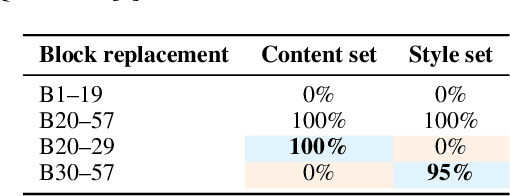
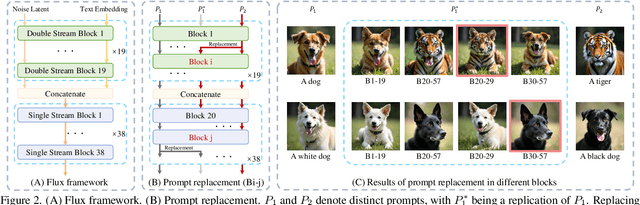

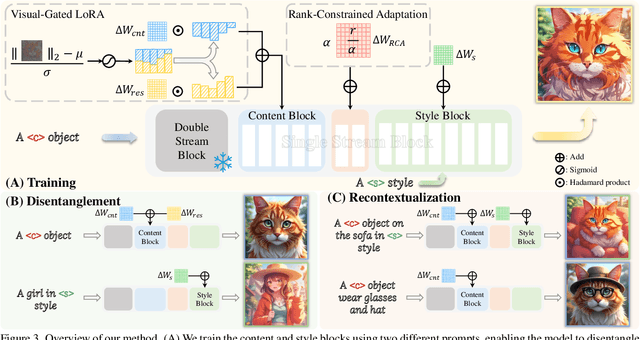
Disentangling image content and style is essential for customized image generation. Existing SDXL-based methods struggle to achieve high-quality results, while the recently proposed Flux model fails to achieve effective content-style separation due to its underexplored characteristics. To address these challenges, we conduct a systematic analysis of Flux and make two key observations: (1) Single Dream Blocks are essential for image generation; and (2) Early single stream blocks mainly control content, whereas later blocks govern style. Based on these insights, we propose SplitFlux, which disentangles content and style by fine-tuning the single dream blocks via LoRA, enabling the disentangled content to be re-embedded into new contexts. It includes two key components: (1) Rank-Constrained Adaptation. To preserve content identity and structure, we compress the rank and amplify the magnitude of updates within specific blocks, preventing content leakage into style blocks. (2) Visual-Gated LoRA. We split the content LoRA into two branches with different ranks, guided by image saliency. The high-rank branch preserves primary subject information, while the low-rank branch encodes residual details, mitigating content overfitting and enabling seamless re-embedding. Extensive experiments demonstrate that SplitFlux consistently outperforms state-of-the-art methods, achieving superior content preservation and stylization quality across diverse scenarios.
FantasyStyle: Controllable Stylized Distillation for 3D Gaussian Splatting
Aug 11, 2025The success of 3DGS in generative and editing applications has sparked growing interest in 3DGS-based style transfer. However, current methods still face two major challenges: (1) multi-view inconsistency often leads to style conflicts, resulting in appearance smoothing and distortion; and (2) heavy reliance on VGG features, which struggle to disentangle style and content from style images, often causing content leakage and excessive stylization. To tackle these issues, we introduce \textbf{FantasyStyle}, a 3DGS-based style transfer framework, and the first to rely entirely on diffusion model distillation. It comprises two key components: (1) \textbf{Multi-View Frequency Consistency}. We enhance cross-view consistency by applying a 3D filter to multi-view noisy latent, selectively reducing low-frequency components to mitigate stylized prior conflicts. (2) \textbf{Controllable Stylized Distillation}. To suppress content leakage from style images, we introduce negative guidance to exclude undesired content. In addition, we identify the limitations of Score Distillation Sampling and Delta Denoising Score in 3D style transfer and remove the reconstruction term accordingly. Building on these insights, we propose a controllable stylized distillation that leverages negative guidance to more effectively optimize the 3D Gaussians. Extensive experiments demonstrate that our method consistently outperforms state-of-the-art approaches, achieving higher stylization quality and visual realism across various scenes and styles.